Posts

Week 8 Blog Post

Lab : Today we had our space presentations. The 6 main topics were the origin of the Universe, the Lifecycles of Stars and galaxies, the Origin of the Earth, black holes, and exploration of space. For Black Holes, I learned that Black holes are formed when a big hole is at the end of its life when it becomes too weak to support its own gravity and collapses on itself. Black holes can also be of different sizes. The parts of the black hole include the event horizon (point of no return), the singularity (center of the black hole gravity becomes super intense becoming infinite), and the accretion disk (found on most black holes is the ring of gas and dust). My group presented on Galaxies, and when I thought I knew a lot about it already, I gained more information yet again. Galaxies consist of stars, planets, and vast clouds of gas and dust, all bound together by gravity. Galaxies are known to also come forward in a variety of shapes, like spirals and ellipticals. Galaxies are typically o...
Week 7 Blog Post

Image
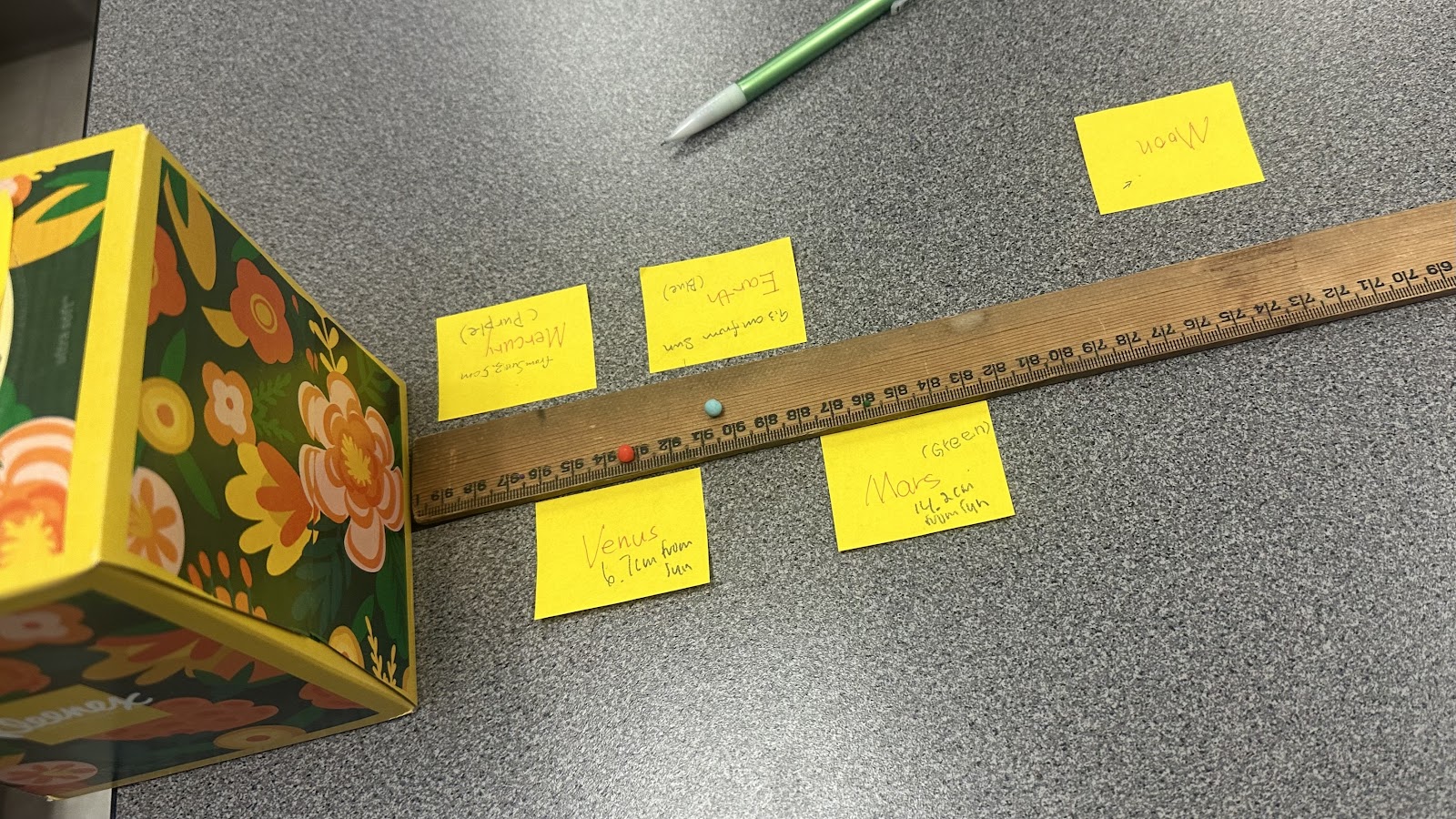
Lab : In the lab for week 7, we were designed to physically build a model of the sun, moon, and the four inner planets. We were instructed that this needed to be by scale. The hardest part was getting each of the planets, the sun, and the moon to be the exactly correct size that it would relate to in real life. We then had to space out all 6 of those in the correct distance that it would be in real life as well. After lots of errors and trials, we finally got all 6 of them to the right distance. Overall, I take away from this investigation just how spread out the moon is from the sun. It was a good way to hands-on work on this by visually being able to tell how spread out everything truly is. Weekly Textbook Reading : Our Solar System- The four inner planets are Mercury, Venus, Earth, and Mars. They are all considered rocky planets because they have a solid outer surface, this was a helpful reminder once again. It was most helpful reading on the section regarding the Sizes and Distance...

Week 6 blog post

Image
Lab Notes:  My understanding of the three questions that were asked of us. The three questions are how the phases of the moon occur, what causes the seasons, and what causes a lunar eclipse. The seasons occur because when the sun moves around the earth depending on the different temperatures like when the sun moves around the earth at different points and spots. The phases of the moon occur because of the phases of the earth, moon, and sun. This affects each other and where the moon and sun are most visible. I learned that a lunar eclipse occurs when the earth comes between the moon and the sun. Lunar Eclipses occur when the sun, earth, and moon are aligned in a perfectly straight line. In lab today we talked all about the earth's systems and what makes all of it up. We also heavily talked about how the Earth, Sun, and Moon are closely related to one another. So, the big question was what makes up the earth, sun, and moon systems! What is a Solar System ? Solar means the sun, the s...

week 5 blog post

Image
In Lab for Week 5, we worked on force and talked about energy and it's focuses. To Discover this we reviewed a pendulum simulation that was swinging back and forth and through a energy lens we were to figure out and look into why a swing slows down and stops sometimes. I took away and came to the conclusion that the pendulum collides with air particles which then speeds the particles up then slows down the pendulum. The collisions transferred energy to the pendulum that is taken from the air actually. From then on we took the ideas of thinking through energy lens into other ways, when another big question example about how we need to keep pushing a child on swing to keep their momentum going. This is due to the collisions with air particles that transfer energy from rider to surrounding air that gets in the way. We also discussed and reviewed what would happen if something fell straight down into a bowl. We were instructed to build something that would stop an egg from breaking whe...

Week 4 Blog Post

In the lab for week 4, we talked a lot about friction and forces. We were reminded that friction is the force that opposes sliding across a surface. Well, today we modeled the question in the lab through investigation in the lab that asked, "What affects how long it takes a swing to go back and forth?". So today in the lab we designed an investigation that had us test this theory out. My group claimed that the faster we push the swing the quicker it will go back and forth. We effectively proved that to be true with our data. We noticed that when we bumped the swing the time it took to go 10 swings took a lot longer then when we pushed the swing harder. In a lecture for week 4, we talked a lot about force and Newton's First Law. I was reminded that Newton's First Law states that without an external force, an object will maintain its speed and direction of motion. Then we went into Newton's second law. Newton's Second law states that larger masses are harder to ...

week 3 blog post

Image
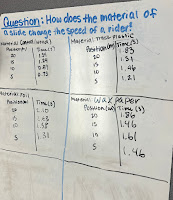
What we did in Monday's Lab : talked about how can we support play that is exciting but not dangerous but this time in the lab we primarily focused on the question of what affects a rider's speed down a slide? By table group, we ended up putting this question to the test where we designed and conducted our own investigation where we also were to support everything with evidence when we could as well. I took away and learned that, What could affect variables of speed down a slide: - rider weight, slide material, rider clothing, initial force of push. for our investigation we decided to focus on slide material. - our question was how does the material of a slide change the speed of a rider? we found that the smoother the material the faster the object would move. The materials we used were wood, plastic, foil, and ceran wrap. This was an interesting investigation that proved that different materials affect a riders speed. What we did in T hursday's Lecture : In the lectu...

Week 2 Blog Post

Lab Week 2 Summary : For week 2 lab, we discussed and went into the idea of how to support play that is exciting but not dangerous through races specifically. So in lab, we practiced a specific exercise that meant acting out a plan to figure out how to make a race exciting between people who run at different speeds. In the end, we had to plan out how to plan a model where two racers finish at the same time even if one runner is slower than the other time we had to figure out ideas of motion and if someone gets a head start or not. Thursday Lecture Summary : Talked about the ideas of modeling races, and what is needed to put a race together. The idea of speeds is important in how the race will unfold and also based upon how long the distance that will be covered is. We also reviewed the NGSS standards and what things would like like when it comes to making observations between different object's motions. To carry out a good investigation we took away that it is important to make obs...